

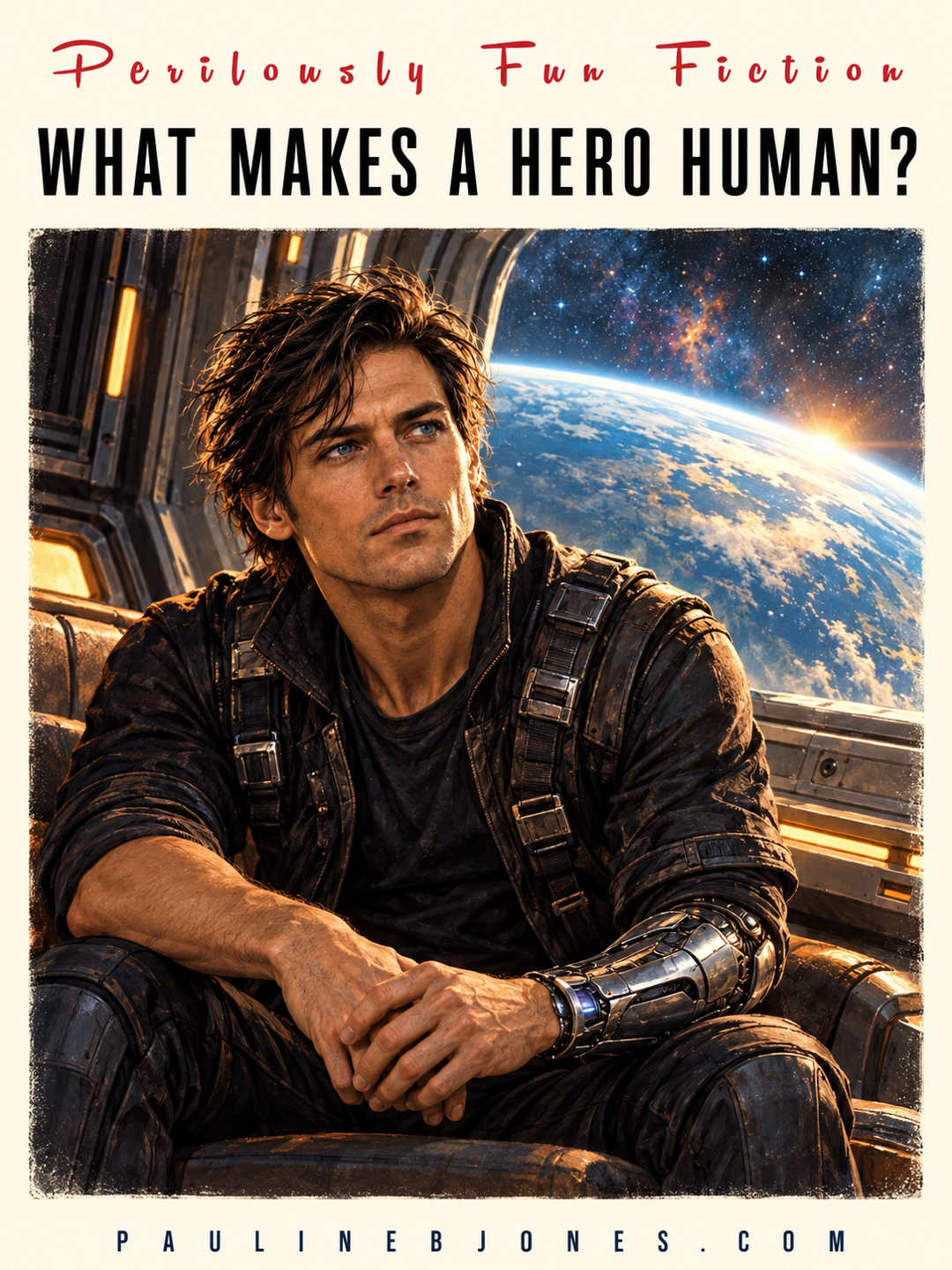
Give a hero a cybernetic arm, and there are certain expectations.
He should be useful in a fight. Probably good with heavy objects. Quite possibly the person you want nearby when a door refuses to open and something unpleasant is approaching from the other side.
All excellent qualifications.
But what happens when the problem is a person he cares about? Someone with reasons to be wary, memories she would rather leave alone, and a smile that suddenly matters more than he expected?
There may not be an enhancement for that.
This is some of the territory I get to explore in TalusH, the latest adventure in my Cyborg Chronicles. There is a dangerous mission, of course. There are complications involving time, which is a particularly inconvenient thing to have misbehave.
But at the center are two people trying to find their way forward—and discovering that forward might be somewhere they want to go together.
A mission sounds straightforward
TalusH, known as Tals, is ready for something to do.
He has returned to a human body with cybernetic enhancements, and he is eager for a mission. Give him a problem to solve. Give him a reason to put his abilities to work.
What makes him interesting to me is the person alongside all that capability.
Early in the book, CabeX describes Tals as someone who can look ahead and figure things out, but also as someone unusually innocent despite everything they have experienced. He is almost incapable of deceit. He can think strategically without losing that essential honesty.
That combination gives us an intriguing hero to send into trouble.
A capable man who means what he says has a great deal to offer. Put him in a situation full of hidden intentions, however, and his strengths become considerably more interesting than a list of upgrades.
How does someone like that navigate people who aren’t being honest? And what happens when the person he wants to protect has every reason to find trust difficult?
Those are the sorts of questions that make me want to keep turning pages—even when I am the one who has to write the next page first.
Lara would like her past to stay in the past
Lara has a new name, a ship of her own, and a small dragon with opinions.
This sounds like a promising arrangement. A ship offers possibilities. A dragon offers companionship, though apparently also commentary.
Unfortunately, a dead man has just tried to kill her.
As objections to a fresh start go, that is fairly emphatic.
Lara is a clone carrying another woman’s memories. She is also carrying the consequences of being used by someone dangerous. Getting away has given her a chance at a different life, but it hasn’t settled everything she feels about herself—or stopped the danger from finding her.
Her circumstances make identity a very personal question. When your memories come with someone else’s history, and someone has tried to turn you into an instrument of his plans, how do you begin to claim your own future?
Lara has knowledge and abilities of her own to bring to the mission. She also has difficult things to face. Protecting her cannot make those things disappear.
Tals may be ready for a problem he can solve. Lara’s life is considerably more complicated than a mission briefing.
Trust is part of the adventure
For me, that is where the romance becomes especially interesting.
Tals and Lara each have a past. Each is adjusting to a life that asks unfamiliar things of them. Neither arrives with everything neatly sorted out.
And then they have to deal with each other.
Attraction can be wonderfully inconvenient. Someone who seemed like part of the assignment begins to matter in a different way. A smile becomes distracting. The future stops being an abstract notion and starts including another person.
Meanwhile, the dangerous outpost is still there. So are the questions about its supposedly dead master. Time has its own complications to contribute.
No one has thoughtfully cleared their schedules so they can explore their feelings.
But danger also gives characters choices. What will they do with the information they have? How will they respond when someone is vulnerable? Can they make room for another person’s judgment, even when protecting that person matters terribly to them?
Those choices help us discover who they are.
More than the useful arm
The science-fiction setting lets me make the question of humanity unusually tangible. Bodies can change. Memories can complicate identity. Abilities can be enhanced.
And still, there is the person making the choices.
Tals’ honesty matters. Lara’s struggle to build a future matters. Their growing connection gives the adventure something personal to put at risk.
A useful arm might get a hero through a locked door. Readers need other reasons to hope he finds happiness on the far side of it.
That is the invitation in TalusH: a perilously fun adventure with dangerous memories, second chances, a rather opinionated dragon, and two people beginning to want a future together.
You can meet them on the TalusH book page.
What makes you root for a hero: honesty, kindness, courage, a sense of humor—or some irresistible combination of all four?
Cybernetic enhancements are optional.