

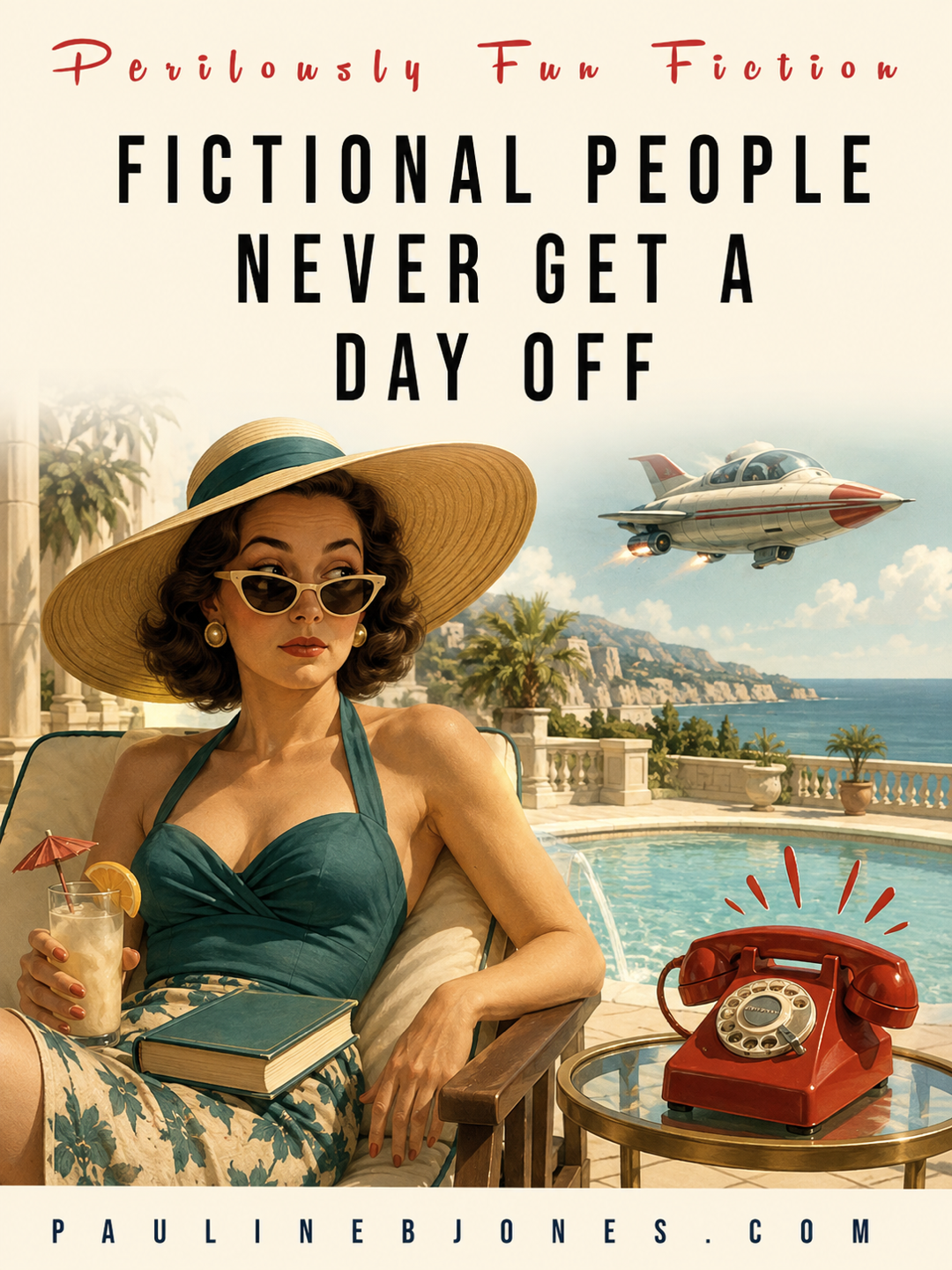
It’s Labor Day, which means many real people are enjoying a well-earned day off.
Fictional people are not.
Somewhere, a mystery heroine has just checked into a charming inn where absolutely no one intends to be murdered. A spaceship captain is answering a distress call that will definitely not lead to an alien conspiracy. A time traveler is promising to take one tiny, harmless peek at the past.
And two people who have no intention of falling in love are being seated next to each other.
Clearly, stories have a very different understanding of the phrase “day off.”
Vacations Are Suspicious
In real life, a vacation might involve sightseeing, sleeping late, or reading a book beside a pool.
In fiction, vacations are traps with attractive scenery.
The characters arrive at a picturesque cottage, a historic hotel, or a remote retreat. They unpack. They admire the view. They make optimistic statements about finally getting some peace and quiet.
Experienced readers immediately become concerned.
We know the cottage has a secret. The hotel has a ghost, a jewel thief, or at least one guest traveling under an assumed name. The remote retreat is remote because help will not be arriving before chapter twenty-seven.
As for the pool? I would check it carefully before getting comfortable.
Competence Is Practically an Invitation to Trouble
Fiction is particularly hard on competent people.
The character who remembers the map will be the one asked to lead everyone through the wilderness. The person with first-aid training will end up tending the wounded. The clever one notices the clue no one else sees, which is useful but rarely restful.
And heaven help the character who says, “I have a bad feeling about this.”
They are always right.
Perhaps this is why stories so often begin with someone trying to live an ordinary life. They have a routine. They have plans. They may even have scheduled time off.
Then a stranger appears, a message arrives, something explodes, or an inconveniently attractive person needs help.
There goes the afternoon.
I’ve sent fictional people into mysteries, outer space, the past, and more dangerous situations than any reasonable person would tolerate. Not one of them has successfully filed a complaint with management.
This is fortunate, because I am management.
Heroes Never Really Clock Out
The trouble with heroes is that they cannot stop being who they are just because they are technically off duty.
They notice when something is wrong.
They step forward when everyone else steps back.
They help the stranded traveler, investigate the strange noise, answer the mysterious message, and go through the door with the warning sign on it.
Sometimes this is bravery. Sometimes it is curiosity. Sometimes it is a spectacular inability to mind their own business.
Often, it is all three.
That may be part of why we love them. A hero is not heroic because life politely schedules trouble during working hours. Courage appears in the inconvenient moments—the ones that interrupt dinner, ruin the vacation, or require someone to crawl out of a comfortable bed.
Characters show us who they are when the day they planned becomes the adventure they did not ask for.
And because we are readers, we get to enjoy the adventure without personally crawling through an air duct, escaping a villain, or explaining to airport security why our luggage contains an ancient artifact that may or may not be cursed.
It is a very sensible arrangement.
The Day Off They Deserve
Still, on this Labor Day, I can’t help wondering what would happen if fictional people received the day off they truly deserve.
The amateur sleuth could visit a village where everyone remained stubbornly alive.
The spaceship crew could explore a peaceful planet without encountering a single hostile life-form, malfunctioning robot, or distress beacon.
The time traveler could enjoy a historical tour without changing the future.
The spy could attend a party where the champagne was only champagne.
And the romantic hero and heroine could have one pleasant conversation without being interrupted by gunfire, secrets, mistaken identities, or a villain with terrible timing.
Of course, none of this would make much of a story.
We might give our heroes the day off, but by page three we’d be peeking around hopefully for trouble.
Perhaps that is the bargain between readers and fictional people. They face the danger, solve the mystery, take the impossible journey, and risk their hearts. We worry about them from a safe and comfortable distance—and promise to keep turning the pages until they finally earn their happy ending.
They may not get Labor Day off.
But if their authors have any mercy at all, they will eventually get a quiet evening, a good meal, and no explosions until the sequel.
Which fictional character do you think most deserves a day off? And what would their perfect, completely trouble-free holiday look like?
Perilously yours,
Pauline